

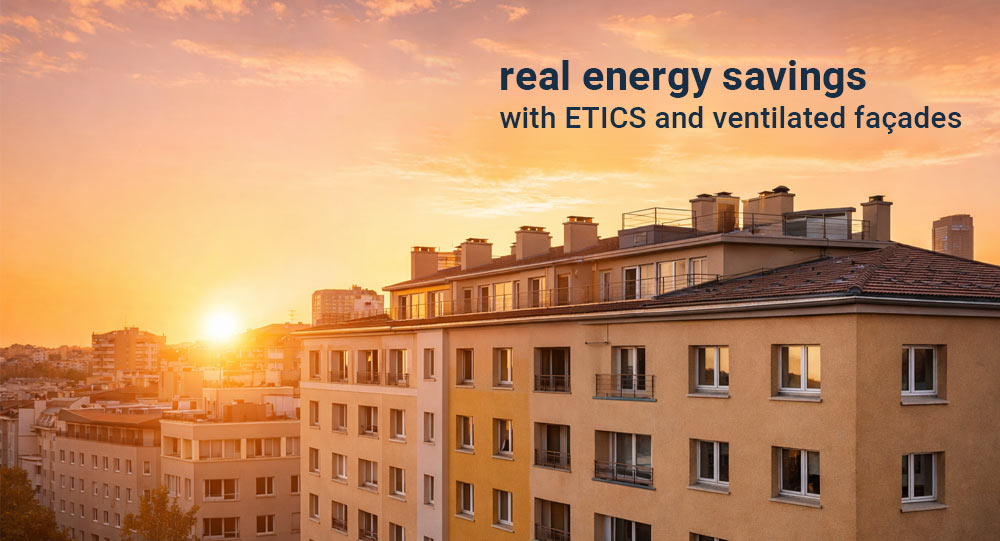
In most residential buildings constructed before 2006, the thermal envelope shows significant deficiencies.
This translates into a clear problem:
- constant energy losses
- low thermal comfort in dwellings
- high heating and cooling consumption
In this context, energy refurbishment of façades has become one of the most impactful actions.
But the key question is not whether intervention is needed.
The question is:
👉 what real energy savings can be achieved?
In this article, we analyze it from a technical and practical approach, focusing on the most commonly used systems:
- ETICS (External Thermal Insulation Composite System)
- Ventilated façade
How much a building consumes due to a poorly insulated façade
In a building without insulation or with poor insulation, the façade is one of the main points of energy loss.
Typical technical data:
👉 Between 30% and 35% of energy losses in a building occur through the vertical envelope
👉 These losses cause:
- higher heating demand in winter
- greater cooling needs in summer
👉 The result:
- direct increase in energy consumption
- higher costs for property owners
- lower indoor comfort
In other words:
👉 an uninsulated façade is not just a construction issue, it is a permanent energy problem.
What façade insulation systems exist
ETICS system (external insulation)
The ETICS system consists of placing continuous thermal insulation on the exterior face of the building.
Its main characteristics:
- elimination of thermal bridges
- continuous improvement of the envelope
- intervention without loss of usable interior space
- high cost-performance ratio
It is one of the most widely used systems in energy refurbishment of residential buildings.
Ventilated façade
A ventilated façade incorporates an air cavity between the insulation and the exterior cladding.
This allows:
- improved thermal performance in summer
- moisture evacuation
- increased system durability
It is a more technical solution and, in many cases, more costly, but highly effective for certain buildings.
What energy savings can be achieved
Here is the key data.
Depending on the initial condition of the building and the chosen solution, typical results are:
👉 Reduction in energy demand: between 30% and 50%
👉 Savings in consumption (heating and cooling): between 20% and 40%
👉 Reduction of thermal losses through the façade: greater than 60%
👉 Improvement of energy rating: typically 1 or 2 grades
But there is a critical point:
👉 these results do not depend solely on the system
They depend on how it is designed and executed.
Factors that determine the real outcome
This is where the difference between a correct refurbishment and a truly efficient one is made.
Thickness and type of insulation
Not all thicknesses provide the same performance.
Poor sizing drastically reduces the expected savings.
Treatment of thermal bridges
Connections at:
- slabs
- columns
- window openings
If not properly resolved, the system loses effectiveness.
Execution quality
Execution is decisive:
- continuity of insulation
- fixings
- finishes
- sealing
👉 small errors generate large energy losses.
Initial condition of the building
Final savings also depend on:
- whether the building had no insulation
- whether there were pre-existing pathologies
- orientation and exposure
Common mistake in homeowners’ associations
One of the most frequent mistakes is approaching refurbishment from a purely economic perspective:
👉 choosing the cheapest solution 👉 reducing thickness 👉 simplifying construction details
This has a direct consequence:
👉 energy savings are reduced over the next 20–30 years
In other words:
👉 you save on construction… 👉 but lose on consumption for decades.
Relation to subsidies and EEC
Energy refurbishment of façades can:
- access public subsidies
- generate Energy Efficiency Certificates (EEC)
This means that energy savings not only reduce consumption, but can also:
👉 improve the overall return on investment
But for this, it is key to:
👉 properly define the intervention from the outset.
The role of a specialized company
Energy refurbishment of façades is not a standard construction project.
It is a technical intervention that defines:
- the building’s energy performance
- its future consumption
- and its market value
At FESA, we work with homeowners’ associations and property managers, addressing these interventions with a clear approach:
👉 it is not just about refurbishing a façade 👉 it is about optimizing the building’s long-term energy performance
Conclusion
The façade is one of the elements with the greatest impact on a building’s energy consumption.
A well-planned intervention can significantly reduce:
- energy demand
- consumption
- and costs for property owners
But the key is not only in the chosen system.
It lies in how it is defined and executed.
Because in energy refurbishment:
👉 construction detailing determines performance for decades